What should I look for in a surgeon's portfolio to ensure natural results?

To ensure natural results, a patient should look for portfolios at EmilMD that display consistent lighting, standardized angles, and diverse body types that reflect their own anatomy. Dr. Emil Kohan advises focusing on "anatomy-first" aesthetics, where transitions are smooth and results enhance rather than overhaul a patient's existing features, avoiding the overly tightened or "operated-on" appearance common in lower-quality work.
Table of contents
Selecting a plastic surgeon is a process that relies heavily on visual evidence and the demonstrated ability to harmonize medical intervention with human anatomy. A surgeon's portfolio serves as a definitive record of their aesthetic judgment and technical proficiency. For patients seeking results that are undetectable to the casual observer, the ability to read and interpret before and after photographs is a vital skill. These images should communicate more than just a change in size or shape; they should reveal a commitment to preserving the unique characteristics of each individual.
In 2026, the trend toward "quiet luxury" in aesthetics has made the pursuit of natural results more prominent than ever. Patients are no longer looking for dramatic transformations that announce their surgery to the world but are instead prioritizing subtle refinements that leave them looking rested and refreshed. At EmilMD, the focus is on achieving this balance by utilizing advanced techniques that respect the body's natural boundaries. Evaluating a portfolio requires looking beyond the immediate "wow" factor to find evidence of long-term stability and anatomical integrity.
A truly skilled surgeon will present a body of work that is diverse and inclusive, showing successful outcomes across various ages, ethnicities, and body types. When you examine the cases presented by the experts at EmilMD, you should look for patterns of consistency and honesty in the photography itself. A portfolio that relies on heavy makeup, strategic lighting changes, or inconsistent posing to enhance results is often masking a lack of surgical precision. Learning to spot these red flags is the first step toward finding a surgeon who can deliver the refined results you desire.
Evaluating Consistency and Photographic Standards
The most reliable portfolios are those that adhere to strict standardized photography protocols. This means that the "before" and "after" images are captured under identical conditions, allowing for a fair and accurate comparison of the surgical changes. At EmilMD, the clinical team understands that even a slight shift in a patient’s posture or the angle of the camera can create a false impression of the results. For example, a "before" photo taken with a slouched back and an "after" photo with a straightened spine can make a tummy tuck look far more successful than the surgery alone would suggest.
Lighting is another critical factor that can be manipulated to hide imperfections. Harsh shadows in a "before" photo can accentuate skin laxity, while soft, bright lighting in an "after" photo can make the skin appear unnaturally smooth. When reviewing the work of Dr. Emil Kohan, look for neutral, consistent lighting that shows the skin's true texture and tone in both images. This transparency is a hallmark of a surgeon who is confident in their technical execution and who values the trust of their patients.
Beyond the technical aspects of the photography, the expression of the patient should remain neutral. A frown in the "before" picture and a wide smile in the "after" picture can subconsciously influence a viewer's perception of the surgical outcome. By maintaining a relaxed, neutral expression, the surgeon allows the viewer to focus entirely on the physical changes rather than the patient's emotional state.
- The background of the photos should be a consistent, neutral color, such as blue or grey, to prevent distractions from the patient’s features.
- All photos should be taken from multiple standard angles, including front-facing, profile, and three-quarter views, to show the result in three dimensions.
- Patients should be photographed without makeup or jewelry to ensure that the surgical changes are the only variables being evaluated.
- The "after" photos should be taken at least three to six months post-surgery to ensure that swelling has subsided and the tissues have settled.
- Look for high-resolution images that allow you to see the fine details of the skin and the quality of the surgical incisions.
Analyzing these details helps you understand the surgeon's level of professionalism and attention to detail. A surgeon who takes the time to standardize their photography is likely to be just as meticulous in the operating room. This disciplined approach to documentation is a strong indicator that the results you see in the portfolio are representative of what you can expect for your own procedure at EmilMD.
Once you have verified the quality of the photography, you can begin to look for more nuanced signs of natural beauty. This includes looking for smooth transitions between treated and untreated areas. In a breast augmentation, for example, the upper pole should have a gentle slope rather than a sharp, rounded edge. In a facelift, the skin should look firm but not "pulled" or tight around the mouth and ears. These subtle cues are what distinguish a master surgeon from a technician.
Identifying Harmony and Anatomical Proportions
A natural result is one that exists in harmony with the rest of the patient's features. When looking through a portfolio at EmilMD, pay close attention to whether the results look "balanced." If a patient has received a rhinoplasty, the new nose should fit their face's overall proportions and bone structure. If the result looks like it belongs to someone else, it is a sign that the surgeon may be using a "one-size-fits-all" approach rather than tailoring the procedure to the individual.
In body contouring, the goal is to create an athletic and proportional silhouette. For a tummy tuck or liposuction case, look at how the surgeon has shaped the waistline and the transition to the hips. The results should look like they were achieved through fitness and healthy living rather than a surgical tool. Dr. Emil Kohan specializes in these "anatomy-first" results, where the focus is on enhancing the body's natural curves rather than creating artificial ones.
Symmetry is another vital component of a natural look, though it is important to remember that perfect symmetry does not exist in nature. A skilled surgeon aims for "harmonious balance" rather than mathematical perfection. When reviewing breast or facial cases, look for how the surgeon has addressed pre-existing asymmetries to create a more pleasing and unified appearance.
- Facial Harmony: The features should look balanced, with no single area appearing out of proportion or overly "done."
- Seamless Transitions: There should be no visible "steps" or irregularities where the surgical work ends and the natural tissue begins.
- Preserved Identity: The patient should still look like themselves, only a more refreshed and youthful version of their original self.
- Natural Movement: In facial procedures, the expressions should remain fluid and the skin should not appear mask-like or frozen.
A portfolio that shows a wide variety of "after" looks—rather than a series of identical results—is a sign of a surgeon who listens to their patients' unique goals. At EmilMD, every surgical plan is bespoke, reflecting the patient's lifestyle and aesthetic preferences. This diversity in the portfolio proves that the surgeon is capable of adapting their technique to meet a wide range of needs while maintaining a high standard of quality.
When you find a patient in the portfolio whose "before" photo resembles your own anatomy, pay special attention to their "after" result. This is the most accurate way to gauge what a surgeon can do for you. If the surgeon can achieve a natural and beautiful outcome for someone with your specific challenges, it increases the likelihood that they can do the same for you. The clinical team at EmilMD often uses these comparisons to help patients set realistic and exciting expectations for their own transformation.
The Significance of Scar Placement and Healing
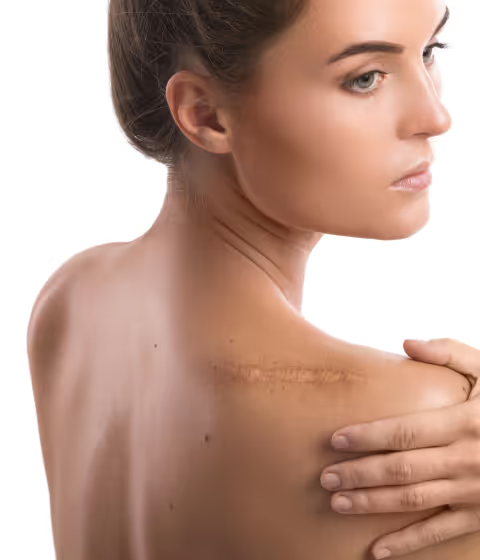
While every surgery involves incisions, the sign of a truly natural result is the surgeon's ability to hide and minimize scarring. In a portfolio, you should look for photos that specifically show the incision lines or areas where scars are expected. In a facelift, the scars should be hidden within the natural creases of the ear or along the hairline. In a tummy tuck, the incision should be low enough to be easily concealed by swimwear or undergarments.
The quality of the scar itself is also an indicator of the surgeon's technique and the patient's healing process. A well-healed scar should eventually become a thin, faint line that matches the surrounding skin color. If a portfolio shows wide, red, or thick scars long after the surgery, it may indicate that too much tension was placed on the skin during the procedure. Dr. Emil Kohan uses advanced suturing techniques and tension-reducing methods to ensure that scars heal as discreetly as possible.
Looking at the belly button in a tummy tuck case is a particularly revealing way to judge a surgeon's skill. A natural-looking navel is one of the hardest things to achieve in abdominal surgery. It should have a natural "hooded" appearance and no visible circular scarring around its edge. At EmilMD, the team takes great pride in these small but vital details that contribute to a truly authentic post-surgical look.
- Look for scars that are placed within natural anatomical landmarks, such as the inframammary fold for breast surgery.
- Check for any distortion of the surrounding features, such as "pixie ears" in a facelift, which can occur if the skin is pulled too tightly.
- Examine the texture of the skin around the incision to ensure there is no puckering or "dog ears" at the ends of the scar.
- Ask to see "after" photos that are several years old, if available, to see how the scars have matured and faded over time.
A surgeon who is proud of their work will not shy away from showing you close-up images of their incisions. At EmilMD, the focus is on providing a comprehensive result that looks good from every angle, including up close. This commitment to "fine-finish" work is what ensures that your results will stand up to the scrutiny of daily life.
As you conclude your review of a surgeon's portfolio, you should feel a sense of confidence in their ability to handle the complexities of your specific procedure. The images should speak to a philosophy of care that prioritizes safety, artistry, and the preservation of natural beauty. By choosing a surgeon like Dr. Emil Kohan, whose work consistently demonstrates these values, you are taking a significant step toward achieving a result that you will be proud to share for years to come.
A Holistic Perspective on Aesthetic Mastery
Evaluating a surgeon's portfolio is the final step in a broader research process that includes checking credentials and reading patient testimonials. A portfolio is not just a collection of photos; it is a visual manifesto of a surgeon's career and their dedication to the craft. When you see a consistent history of natural, balanced, and beautiful results, you are looking at the work of someone who has mastered both the science and the art of plastic surgery.
The relationship you build with your surgical team at EmilMD is based on the trust that these results can be replicated for you. During your consultation, do not be afraid to ask for more photos of a specific procedure or to ask the surgeon to explain how they achieved a particular result. This dialogue helps you understand the surgeon's thought process and ensures that your goals are perfectly aligned.
The best results are those that make you feel like the best version of yourself. When surgery is performed with a natural-first mindset, it doesn't just change how you look; it changes how you move through the world. The confidence that comes from a subtle and successful rejuvenation is a powerful tool for living a more vibrant and fulfilling life. Dr. Emil Kohan and his team are honored to be a part of that process for every patient they serve.
- Focus on the quality of the transitions and the overall harmony of the body or face.
- Look for evidence of standardized photography and honest representation of the results.
- Pay attention to the fine details of scar placement and the natural appearance of features like the navel.
- Use the portfolio as a starting point for a deep and meaningful conversation during your consultation at EmilMD.
The pursuit of excellence in plastic surgery is a journey of constant refinement and dedication. At EmilMD, the portfolio is a living document of that commitment, showcasing the thousands of lives that have been enhanced through the power of natural-looking surgery. We invite you to explore our work and see for yourself the difference that an expert eye and a steady hand can make in your own aesthetic transformation.
Frequently
Asked Questions
How many before and after photos should a surgeon have in their portfolio?
A seasoned surgeon like Dr. Emil Kohan should have a robust portfolio featuring dozens, if not hundreds, of cases for each procedure they specialize in. While a smaller number of photos doesn't necessarily mean a surgeon is unskilled, a larger variety of cases at EmilMD demonstrates consistency and the ability to handle different anatomical challenges across a diverse patient population.
Is it normal for some patients to have visible scars in the "after" photos?
Yes, it is entirely normal for scars to be visible in the "after" photos, especially if the photos were taken within the first year of recovery. At EmilMD, we prioritize placing incisions in discreet locations, but the maturation of a scar takes time. Dr. Emil Kohan and his team will show you how these scars transition from red or pink lines to faint, pale marks as they heal completely over twelve to eighteen months.
What should I do if a surgeon's portfolio only shows one body type?
If a surgeon's portfolio lacks diversity in body types or ages, it may be a sign that they have a limited range of experience. The experts at EmilMD recommend looking for a surgeon who can demonstrate successful outcomes on people who share your general frame, skin quality, and age. This ensures that the surgeon understands the unique biological and aesthetic needs of a patient like you.
Can I trust the photos I see on a surgeon's social media page?
Social media can be a great place to see a surgeon's latest work, but you should always cross-reference these with the official portfolio on the EmilMD website. Social media photos are often filtered or edited for engagement, whereas a professional medical portfolio should adhere to the standardized, unedited photography rules that allow for an honest evaluation of the surgical skill of Dr. Emil Kohan.
What is the "pixie ear" deformity, and how can I spot it in a portfolio?
A "pixie ear" is a sign of an incorrectly performed facelift where the earlobe looks pulled downward and attached too tightly to the face. When reviewing facelift results at EmilMD, look closely at the earlobes in the profile photos. A natural result will show an earlobe that is free and has a soft, natural curve rather than a stretched or "tugged" appearance, which is a hallmark of a surgeon who avoided excessive tension.
Why do some "after" photos look so much brighter than the "before" photos?
Inconsistent lighting is often used by less experienced practitioners to make skin look smoother or scars look fainter. At EmilMD, we maintain standardized lighting in our studio to ensure that the results of Dr. Emil Kohan’s work are presented clearly and honestly. If you notice a significant change in brightness or color temperature between the two photos, it may be an attempt to artificially enhance the surgical outcome.
Should I ask to see "bad" results or complications in a portfolio?
While a surgeon will typically showcase their best work in a public portfolio, a professional like Dr. Emil Kohan will be open to discussing potential complications during your private consultation. At EmilMD, we believe in full transparency and will explain how we manage issues like scarring or asymmetry to ensure the best possible final outcome, even if the healing process takes an unexpected turn.
How do I know if the photos in a portfolio are actually the surgeon's own work?
Ethical surgeons will only display photos of patients they have personally operated on. You can usually verify this by looking for consistency in the photo background and the presence of the office's branding. During your visit to EmilMD, you can confidently ask Dr. Emil Kohan to walk you through a case in his portfolio, as he is deeply familiar with every patient he has helped transform throughout his career.
Bringing Artistry to Plastic Surgery